The fitness skill most adults over 40 overlook — and the one that could save your life.
Introduction
Michael, 62, considered himself active. He walked three miles every morning, lifted weights twice a week, and watched what he ate. Then one ordinary Tuesday, he stepped off a curb wrong and ended up in the emergency room with a fractured ankle. “I had no idea my balance had gotten that bad,” he said. “I thought that was something that happened to old people.”
Here’s the hard truth: balance begins to decline as early as your late 30s, and the consequences can be severe. According to the CDC, falls are the leading cause of injury-related death among adults aged 65 and older, and every year, about 36 million falls occur among older adults in the United States. But the encouraging news is that balance is trainable at any age.
In this guide, you’ll learn exactly what balance and stability training involves, why it becomes critical after 40, and how to build a practical routine that protects you for decades to come.
What Is Balance and Stability Training?
Balance training refers to exercises specifically designed to improve your body’s ability to maintain controlled positions, whether you’re standing still, moving, or reacting to unexpected forces. Stability training, while closely related, focuses on strengthening the deep postural muscles — especially those in your core, hips, and ankles — that keep your joints aligned and your body upright.
Your balance system relies on three interconnected inputs:
- The vestibular system — located in your inner ear, it detects head movements and changes in position
- Proprioception — the body’s internal sense of where your limbs are in space, fed by sensors in your muscles, joints, and tendons
- Vision — your eyes provide critical orientation cues, especially in low-light environments
When any one of these systems weakens — through aging, inactivity, medication side effects, or neurological changes — your overall balance is compromised.
The National Institute on Aging notes that reduced muscle strength, slower nerve conduction, and decreased joint flexibility all contribute to the gradual deterioration of balance. These changes are normal, but they are not inevitable in their severity. Research consistently shows that targeted balance training can significantly offset these age-related declines.
Signs Your Balance May Be Declining
Many people don’t notice balance problems until a near-fall or actual fall brings them to attention. Recognizing earlier, subtler warning signs gives you the opportunity to act before injury occurs.
Early warning signs:
- Reaching for walls or furniture when walking through a room
- Difficulty standing on one foot for more than 5 to 10 seconds
- Feeling unsteady on uneven surfaces like grass or gravel
- Stumbling when you turn around quickly
- Needing to look down at your feet while walking stairs
- Feeling dizzy or lightheaded when you stand up quickly
More advanced signs that warrant medical evaluation:
- Frequent stumbling or near-falls
- Loss of balance during ordinary daily activities
- Significant wobbling when walking in the dark
- Feeling “off” or unsteady without a clear reason
A 2020 study published in the British Journal of Sports Medicine found that adults who could not stand on one leg for 10 seconds had a significantly higher risk of mortality from all causes over a follow-up period. While this doesn’t mean every person with poor balance is in immediate danger, it does underscore how closely physical stability correlates with overall health status.
This varies from person to person, and many factors — including recent illness, certain medications, and inner ear conditions — can temporarily affect balance. Always mention new or worsening balance changes to your physician.
Causes and Risk Factors
Understanding why balance declines after 40 helps you target the right solutions.
Age-related physiological changes:
- Muscle loss (sarcopenia): Adults can lose 3 to 8 percent of muscle mass per decade after age 30, according to research published in the Journal of Cachexia, Sarcopenia and Muscle. Less muscle means less joint support and slower reaction time.
- Reduced nerve conduction speed: Proprioceptive signals travel more slowly as you age, meaning your body responds to balance threats less quickly.
- Inner ear changes: The hair cells that detect movement in the vestibular system gradually diminish, particularly after age 50.
- Vision decline: Even mild vision loss, including reduced contrast sensitivity and depth perception, impairs balance significantly.
Lifestyle and medical risk factors:
- Sedentary lifestyle — the single most modifiable risk factor
- Medications including certain blood pressure drugs, sleep aids, antihistamines, and antidepressants
- Chronic conditions such as diabetes (which causes peripheral neuropathy), Parkinson’s disease, and inner ear disorders
- History of stroke or traumatic brain injury
- Vitamin D deficiency — linked to increased fall risk in multiple NIH-supported studies
- Poorly fitted footwear
The CDC reports that four out of five fall-related deaths occur in adults aged 75 and older, but the balance decline that creates that vulnerability typically begins 20 to 30 years earlier. That window is your opportunity.
Diagnosis: What to Expect from a Medical Assessment
If you’re concerned about your balance, your primary care physician or a physical therapist can conduct a formal assessment. Knowing what to expect removes the anxiety from the process.
Common clinical balance tests include:
- Timed Up and Go (TUG) test: You rise from a chair, walk 10 feet, return, and sit down. A time greater than 12 seconds is associated with increased fall risk.
- Single-leg stance test: Standing on one leg with eyes open and then closed measures the contribution of each balance system.
- Berg Balance Scale: A 14-item functional test commonly used in clinical rehabilitation settings.
- Romberg test: Standing with feet together, arms at sides, first with eyes open, then closed — used to distinguish between proprioceptive and vestibular causes of instability.
Your doctor may also review your medication list, check your vitamin D and B12 levels, evaluate your vision, and assess your footwear. In some cases, referral to a vestibular specialist, neurologist, or physical therapist specializing in fall prevention may be recommended.
Most physicians recommend a balance assessment for any adult who has experienced a fall, near-fall, or reports feeling increasingly unsteady — regardless of age.
Balance and Stability Exercises: Building Your Routine
Clinical evidence strongly supports structured balance training as an effective intervention for adults of all fitness levels. A 2019 Cochrane Review analyzing over 77 trials found that exercise programs that include balance and functional training reduce fall rates by approximately 23 percent in older adults.
The key is starting at your current level and progressing gradually. Always perform balance exercises near a wall or sturdy chair for safety, especially when you’re just beginning.
Beginner Level: Building the Foundation
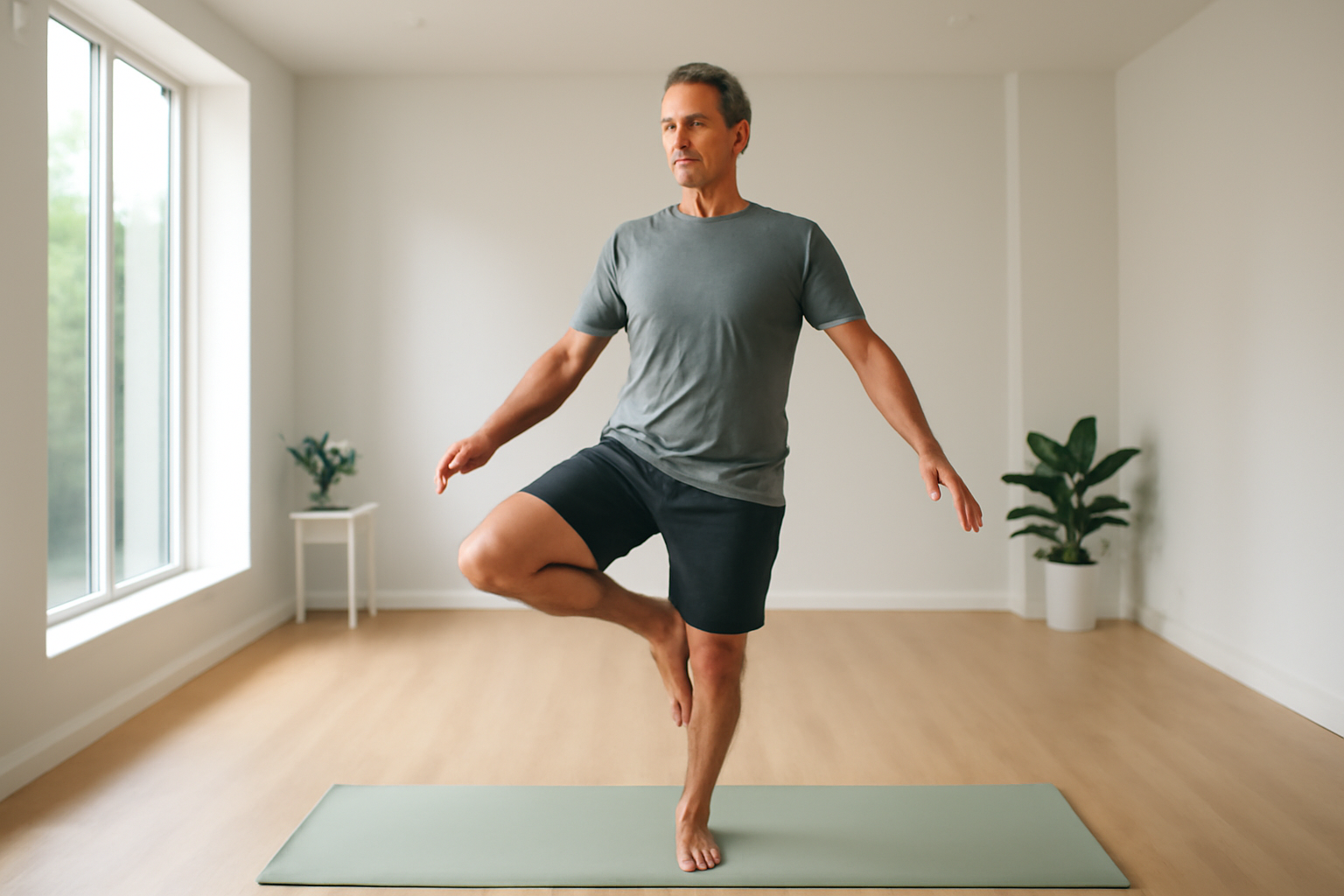
- Single-leg stand: Stand on one foot for 10 to 30 seconds, holding a wall if needed. Switch sides. Perform 3 repetitions per leg, twice daily.
- Heel-to-toe walking (tandem walk): Walk in a straight line placing the heel of one foot directly in front of the toes of the other. Aim for 20 steps.
- Sit-to-stand: Rise from a chair without using your hands. This builds critical hip and quad strength. Perform 10 repetitions.
- Weight shifts: Stand with feet hip-width apart and slowly shift your weight from foot to foot, holding each position for 3 to 5 seconds.
Intermediate Level: Adding Challenge
- Single-leg stand with eyes closed: Closes the visual loop and forces your vestibular and proprioceptive systems to work harder.
- Side steps with resistance band: A mini-band around your ankles during lateral steps targets the hip abductors — critical stabilizers for the knee and ankle.
- Standing on an unstable surface: A folded exercise mat or balance disc adds proprioceptive challenge without high risk.
- Tai chi movements: Clinical evidence from Johns Hopkins Medicine supports tai chi as one of the most effective balance training methods for adults over 50, showing fall risk reductions of up to 47 percent in some studies.
Advanced Level: Dynamic Stability
- Single-leg deadlift: Holding a light weight, hinge forward at the hip with one leg extended behind. This builds hip stability and trains balance under load.
- Lateral lunges: Step wide to one side, bending the stepping knee while the other stays straight. Builds hip strength in the frontal plane.
- Bosu ball exercises: Squats or single-leg stands on an unstable dome surface significantly increase neuromuscular demand.
If you’re also working on strength and cardio fitness, many of these exercises complement the work covered in our Strength Training After 40: The Complete Guide to Building Muscle Safely and our Cardio After 40: The Complete Guide to Heart-Healthy Exercise. Balance training is most effective when paired with a well-rounded fitness routine.
Living With Balance Challenges: Day-to-Day Management and Prevention
Exercise is only one piece of the puzzle. Managing your environment and daily habits can dramatically reduce fall risk, particularly during the years before your training adaptations fully take hold.
Home safety modifications:
- Install grab bars in the shower and near the toilet
- Remove loose rugs or secure them with non-slip backing
- Ensure all stairways have secure handrails on both sides
- Keep pathways well-lit, particularly at night — use motion-sensor nightlights
- Move frequently used items to shelves between waist and shoulder height
Footwear and orthotics:
Research suggests that footwear with thin, firm soles and low heels provides better proprioceptive feedback than thick, cushioned shoes for balance purposes. Avoid walking in socks on smooth floors. A podiatrist can assess whether custom orthotics might help address gait or ankle instability issues.
Nutrition and supplementation:
Vitamin D deficiency is associated with muscle weakness and increased fall risk. The NIH recommends adults aged 51 to 70 consume 600 IU of vitamin D daily, with the threshold rising to 800 IU after age 70. However, dosing should always be guided by your physician based on lab values. Adequate protein intake also supports the muscle mass maintenance critical to stability.
If you’re interested in complementing your balance work with mobility training, our guide on Flexibility & Mobility Training: The Complete Guide for Adults Over 40 offers practical strategies that directly support stability and injury prevention.
When to Call Your Doctor: Emergency Signs and Red Flags
Not all balance problems are exercise-related, and some require prompt medical attention. Know the difference between a fitness challenge and a medical warning sign.
Seek emergency care immediately if you experience:
- Sudden, severe dizziness or vertigo with no prior history
- Loss of balance accompanied by slurred speech, facial drooping, arm weakness, or vision changes (these may indicate stroke — call 911 immediately)
- Sudden hearing loss combined with dizziness
- Loss of consciousness or fainting
- Severe headache alongside balance loss
Schedule a non-emergency appointment if you notice:
- Gradual but noticeable worsening of balance over weeks or months
- Recurring dizziness upon standing up
- A recent fall, even if no injury occurred
- Numbness or tingling in your feet that affects how you walk
- New medications that seem to be affecting your steadiness
When you see your doctor, be specific: describe when it happens, how long it lasts, whether it’s associated with head movements, and any medications you’ve recently started or changed.
Frequently Asked Questions
How long does it take to see results from balance training?
Most people begin noticing improvements in stability and confidence within 4 to 6 weeks of consistent practice. Clinical evidence from the Mayo Clinic suggests that meaningful reductions in fall risk can be achieved with as little as two to three sessions per week over 12 weeks. That said, this varies from person to person depending on starting fitness level and consistency.
Is yoga effective for balance training?
Yes — research suggests yoga is a clinically recognized approach to improving balance, proprioception, and core strength. Poses like tree pose, warrior III, and chair pose specifically challenge the same systems involved in everyday stability. Many physicians recommend yoga as a complementary approach, particularly for adults who prefer low-impact activity.
Can medications be causing my balance problems?
Absolutely. Several commonly prescribed medications are associated with dizziness and impaired balance, including certain antihypertensives (blood pressure drugs), benzodiazepines, anticonvulsants, opioids, and some antihistamines. Clinical evidence indicates that polypharmacy — taking multiple medications simultaneously — significantly increases fall risk. Talk to your doctor or pharmacist if you suspect your medications are affecting your steadiness. Never stop or adjust medications on your own.
What’s the difference between balance training and core training?
Core training focuses specifically on strengthening the muscles of the abdomen, back, pelvis, and hips. Balance training uses these muscles — along with ankle stabilizers and the neurological systems of proprioception and vestibular function — in integrated, functional movements. In practice, the two overlap significantly. Most physical therapists recommend training both together, as a strong core is foundational to better balance.
Should I see a physical therapist or can I train on my own?
For most healthy adults with mild balance concerns, a home-based program using the beginner exercises above is a reasonable starting point. However, if you have a history of falls, a neurological condition, significant arthritis, or unresolved dizziness, working with a licensed physical therapist — ideally one certified in vestibular rehabilitation or fall prevention — is strongly recommended by most physicians before starting independently.
Conclusion
Balance is a skill — and like any skill, it responds to practice, challenge, and consistency. The fact that it declines with age doesn’t mean you have to accept poor stability as inevitable. Research clearly indicates that targeted balance and stability training reduces fall risk, improves functional independence, and even correlates with better long-term health outcomes.
Start where you are. Begin with simple single-leg stands next to the kitchen counter. Add a few minutes of mindful, heel-to-toe walking. Progress at a pace that feels safe and sustainable. Combine your balance work with strength and cardiovascular training for a complete picture of fitness after 40.
Most importantly, talk to your doctor about your balance concerns. A conversation today could prevent an injury tomorrow — and that conversation is always worth having.
Medical Disclaimer: This article is for informational and educational purposes only. It does not constitute medical advice, diagnosis, or treatment. Always consult your physician or a qualified healthcare provider before making changes to your health routine or treatment plan.
Medically reviewed by our editorial health team. Content follows evidence-based standards aligned with CDC and NIH guidelines.