Tag: functional fitness

  • Kettlebell Training After 40: Build Strength and Burn Fat

    Kettlebell Training After 40: Build Strength and Burn Fat

    Kettlebell Training After 40: Build Strength and Burn Fat

    One piece of equipment, dozens of movements — and the science to back it up for adults over 40.

    Why Kettlebells Deserve a Place in Your Fitness Routine

    Mark, 52, had spent years running on a treadmill and lifting machines at his local gym. He was doing everything "right" — yet he kept gaining weight around his midsection, his back ached after long workdays, and he never seemed to build the functional strength he actually needed in daily life.

    A physical therapist suggested he try kettlebell training. Within twelve weeks, his posture improved, his lower back pain decreased significantly, and he had lost eight pounds without changing his diet dramatically. "I wish I had started this ten years ago," he said.

    According to the CDC, fewer than 25% of American adults meet both aerobic and muscle-strengthening guidelines — and that gap widens significantly after age 40. Kettlebell training is one of the few exercise modalities that targets both in a single session.

    In this guide, you’ll learn exactly what kettlebell training is, why it’s particularly well-suited for adults aged 30 to 70, what the research says about its benefits, and how to get started safely — even if you’ve never picked one up before.

    What Is Kettlebell Training?

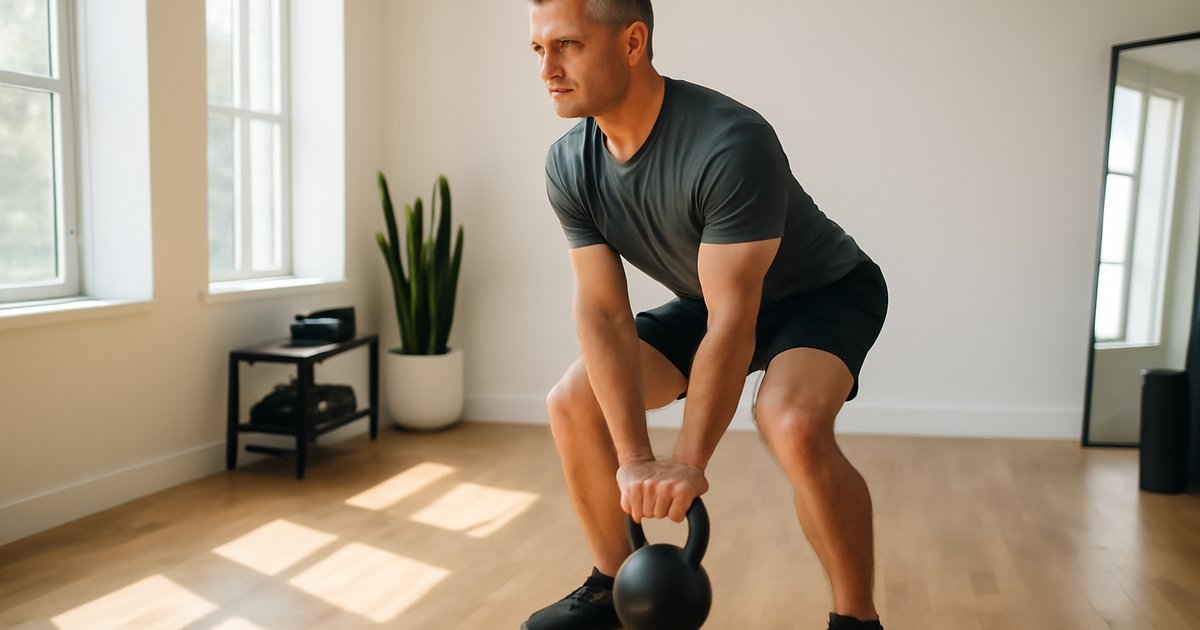
    A kettlebell is a cast-iron or steel weight shaped like a cannonball with a flat base and a thick handle on top. Unlike dumbbells, the weight hangs below the handle, which shifts your center of gravity and forces your stabilizing muscles — the smaller, deeper muscles around your joints — to work constantly throughout every movement.

    Kettlebell training uses dynamic, ballistic, and grinding movements that blend strength, cardiovascular conditioning, and mobility into a single workout. Common exercises include the kettlebell swing, goblet squat, Turkish get-up, and clean and press.

    According to research published in the Journal of Strength and Conditioning Research, kettlebell training can simultaneously improve muscular strength, aerobic capacity, and dynamic balance — three physical qualities that decline significantly with age if left untrained.

    In the United States, kettlebell use has grown steadily since the early 2000s and is now a standard tool in physical therapy clinics, CrossFit boxes, and mainstream gyms alike. It’s no longer a niche modality — it’s a clinically supported training approach for all fitness levels.

    Signs Your Current Routine May Not Be Enough

    You may benefit from adding kettlebell training to your program if you notice several of the following patterns:

    Early warning signs that your fitness foundation needs work:

    • Chronic lower back or hip tightness after sitting for long periods
    • Difficulty carrying groceries, climbing stairs, or lifting objects from the floor
    • Plateau in weight or body composition despite consistent cardio
    • Loss of grip strength — dropping things more easily than before
    • Poor posture that worsens throughout the day
    • Feeling winded during moderate physical tasks

    More advanced signs of deconditioning:

    • Balance issues when standing on one leg or stepping over objects
    • Joint pain during traditional weightlifting exercises
    • Significant loss of muscle tone in legs, glutes, and core
    • Fatigue after brief physical activity that used to feel effortless

    A 2021 meta-analysis from the International Journal of Environmental Research and Public Health found that adults over 40 who engage in functional resistance training — which kettlebells exemplify — show measurable improvements in mobility, strength, and cardiovascular health markers in as little as eight weeks.

    Why Adults Over 40 Respond So Well to Kettlebell Training

    After age 40, the body undergoes several physiological changes that make kettlebell training especially valuable. Understanding these changes can help you train smarter rather than harder.

    Sarcopenia — muscle loss with age
    The NIH estimates that adults lose 3–8% of muscle mass per decade after age 30, with losses accelerating after 60. Resistance training, including kettlebell work, is the single most effective intervention to slow and partially reverse this process.

    Hormonal shifts
    Both men and women experience declining testosterone and estrogen after 40, which affects fat distribution and recovery time. Compound movements like kettlebell swings and cleans stimulate a favorable hormonal response — including a transient release of growth hormone — more effectively than isolated machine exercises.

    Joint health considerations
    Many adults over 40 find traditional barbell lifting aggravates old injuries. Kettlebells allow a more natural arc of movement, reducing shear forces on the knee and lower back while still loading the muscles effectively. This makes them a preferred tool in many physical therapy and orthopedic rehabilitation settings.

    Cardiovascular efficiency
    Research published in the Journal of Human Kinetics found that a 12-minute kettlebell workout elevated heart rate to approximately 87% of maximum — equivalent to running at a moderate pace. This means kettlebell training can provide meaningful cardiovascular conditioning without the joint impact of running, which is particularly important for adults managing knee or hip concerns.

    If you’re already doing some resistance work and want to compare how kettlebells fit alongside other modalities, you might explore our guide on Dumbbell Workouts After 40: Build Strength Safely and our overview of Exercise for Bone Health After 40: Build Density & Strength for additional context.

    Diagnosis: Understanding Your Fitness Starting Point

    Before starting any new training program, and especially one that involves ballistic movements like kettlebell swings, it’s wise to assess where you currently stand physically. This isn’t about passing or failing — it’s about training safely and effectively.

    What your doctor may evaluate before you begin:

    • Blood pressure and resting heart rate
    • Bone density screening if you’re over 50 or postmenopausal
    • History of joint injuries, herniated discs, or cardiovascular conditions
    • Balance and gait assessment if fall risk is a concern

    Self-assessment basics:

    • Can you perform a bodyweight squat with good form — knees tracking over toes, chest upright, hips below parallel?
    • Can you perform a hip hinge — pushing hips back while keeping your spine neutral — without rounding your lower back?
    • Can you hold a plank for 20–30 seconds without compensating?

    If any of these movements are uncomfortable or feel unstable, working with a certified personal trainer or physical therapist for your first few sessions is a reasonable and worthwhile investment. The American Council on Exercise and the National Strength and Conditioning Association both certify trainers in kettlebell instruction specifically.

    Most physicians will support kettlebell training for adults over 40 when it begins at an appropriate weight — typically 8–12 kg (18–26 lbs) for women and 12–16 kg (26–35 lbs) for men new to the practice — and progresses gradually.

    Kettlebell Training: Exercises, Plans, and Evidence

    Kettlebell training is built around a small set of foundational movements that can be combined in hundreds of ways. Here’s what clinical and performance research supports most strongly for adults over 40:

    The Kettlebell Swing

    The swing is the cornerstone movement of kettlebell training. It trains the posterior chain — glutes, hamstrings, lower back — through a powerful hip hinge. A 2012 study in the Journal of Strength and Conditioning Research found that consistent swing training significantly reduced chronic lower back pain in participants.

    It is not a squat — it’s a hinge. The power comes from driving your hips forward explosively, not from lifting with your arms or squatting down.

    The Goblet Squat

    Holding a kettlebell at chest height counterbalances your weight, making it easier to squat deeper with better form. Research suggests this is one of the safest and most effective squat variations for adults who have knee or hip limitations.

    The Turkish Get-Up

    This full-body movement takes you from lying on the floor to standing upright while holding a kettlebell overhead. It builds shoulder stability, hip mobility, and core strength simultaneously — and clinical evidence indicates it can improve functional movement patterns relevant to fall prevention in older adults.

    The Clean and Press

    A two-phase movement that combines a hip-powered pull to rack the bell at shoulder height, followed by an overhead press. It trains full-body coordination, grip strength, and overhead stability — all of which tend to decline significantly after 40.

    Sample Weekly Structure for Adults Over 40

    Research supports three training sessions per week with at least one full rest day between sessions. This frequency allows adequate recovery while producing consistent adaptation:

    • Day 1: Swings, goblet squats, core work — 30–40 minutes
    • Day 2: Rest or light walking, stretching
    • Day 3: Turkish get-ups, rows, single-leg deadlifts — 30–40 minutes
    • Day 4: Rest or low-impact activity
    • Day 5: Full-body circuit combining swings, cleans, and presses — 30–45 minutes
    • Days 6–7: Active recovery, mobility work, or gentle walking

    For complementary mobility work to support your kettlebell practice, our guide on Stretching After 40: Routines for Flexibility & Pain Relief offers a structured approach to maintaining the range of motion kettlebell training demands.

    Living With Your Program: Day-to-Day Management and Prevention

    Consistency matters far more than intensity. A moderate kettlebell routine practiced three times a week, year-round, will produce dramatically better outcomes than aggressive bursts followed by long breaks.

    Practical strategies that support long-term success:

    • Prioritize warm-up: Spend 8–10 minutes on hip circles, thoracic rotations, and bodyweight hinges before picking up any weight. Cold tissue is more vulnerable to strain.
    • Progress weight slowly: Add weight only when you can perform all reps of an exercise with clean, controlled technique. Most adults benefit from spending 4–6 weeks at each weight before progressing.
    • Protect your hands: Kettlebell handles can cause callusing and tearing. Chalk, light gloves, or hand care routines help maintain training consistency.
    • Track your sessions: A simple log of exercises, weights, and sets helps you recognize progress and signals when you may be overtraining or plateauing.
    • Fuel appropriately: Protein intake is especially important after 40 to support muscle repair. Most clinical guidelines suggest 0.7–1 gram of protein per pound of bodyweight for active adults — discuss your specific needs with your physician or a registered dietitian.

    Prevention benefits beyond the gym:
    Regular kettlebell training has been associated in research with reductions in fasting blood glucose, improved lipid profiles, lower resting blood pressure, and better insulin sensitivity — all of which are meaningful preventive health factors for adults in the 40–70 age range.

    When to Call Your Doctor or Seek Emergency Care

    Kettlebell training is generally safe for healthy adults, but like any physical training, it carries risks that require medical attention in certain circumstances.

    Contact your doctor before starting or continuing if you experience:

    • New or worsening joint pain that persists for more than 48 hours after a session
    • Sharp or radiating pain in the back, hip, or shoulder during or after exercise
    • Unusual swelling in a joint following training
    • Persistent dizziness or lightheadedness during workouts
    • Numbness or tingling in the arms or legs during or after training

    Seek emergency medical care immediately if you experience:

    • Chest pain, pressure, or tightness during exercise
    • Sudden shortness of breath that doesn’t resolve with rest
    • Heart palpitations that feel rapid, irregular, or uncomfortable
    • Sudden severe headache during exertion
    • Loss of consciousness or near-fainting during a workout

    These symptoms are not typical exercise discomfort — they require evaluation. Do not return to training until you’ve been cleared by a healthcare provider.

    What to tell your doctor at your next visit:
    Mention that you’re starting kettlebell training, describe the weight and volume you plan to use, and ask whether any existing conditions — including blood pressure, cardiovascular history, or joint issues — require modification to your program.

    Frequently Asked Questions About Kettlebell Training After 40

    Q: Is kettlebell training safe if I have lower back pain?
    Research suggests that properly performed kettlebell swings can actually strengthen the muscles that support the lumbar spine and reduce chronic low back pain over time. However, if you have an active disc injury, herniation, or spinal stenosis, you should consult your physician or physical therapist before beginning. Technique matters enormously — poor form during swings or deadlifts can aggravate existing conditions.

    Q: How heavy should my first kettlebell be?
    Most fitness professionals recommend that women new to kettlebell training begin with an 8 kg (18 lb) bell and men with a 12 kg (26 lb) bell for most foundational movements. This varies by individual fitness level. When in doubt, go lighter and perfect your technique before adding load. This varies from person to person based on prior training experience and any existing physical limitations.

    Q: Can kettlebell training help with weight loss after 40?
    Clinical evidence indicates that kettlebell training burns a substantial number of calories — the American Council on Exercise estimates approximately 20 calories per minute during high-effort kettlebell circuits — while also building lean muscle that raises your resting metabolic rate. Combined with appropriate nutrition, it can meaningfully support body composition goals for adults over 40.

    Q: How does kettlebell training compare to traditional weightlifting for older adults?
    Both modalities build strength, but kettlebell training uniquely combines conditioning, mobility, and stability training in a single session. For adults with limited training time or those managing multiple fitness goals simultaneously, research suggests kettlebells offer a more efficient training stimulus. That said, both approaches have merit and many adults benefit from combining them.

    Q: How long before I see results from kettlebell training?
    Most adults report noticeable improvements in energy, posture, and daily functional strength within four to six weeks of consistent three-day-per-week training. Body composition changes — visible muscle tone and fat reduction — typically emerge at eight to twelve weeks, consistent with findings from most resistance training research in this age group.

    A Realistic, Empowering Path Forward

    Kettlebell training after 40 isn’t about training like you did at 25. It’s about training in a way that reflects where you are now — and builds toward where you want to be at 55, 65, or beyond.

    The research is consistent: adults who maintain regular resistance training age better, manage chronic conditions more effectively, and maintain their independence longer. Kettlebells are one of the most practical, evidence-supported tools for making that happen — accessible, time-efficient, and adaptable to virtually any fitness level.

    Start conservatively. Focus on technique over weight. Work with a qualified trainer if you’re new to the movements. And most importantly, keep showing up. The cumulative effect of consistent effort is what produces lasting change.

    Talk with your physician about incorporating kettlebell training into your routine, especially if you’re managing any chronic conditions. This guide is a starting point — your healthcare team is your partner in making it work safely for you.


    Medical Disclaimer: This article is for informational and educational purposes only. It does not constitute medical advice, diagnosis, or treatment. Always consult your physician or a qualified healthcare provider before making changes to your health routine or treatment plan.

    Medically reviewed by our editorial health team. Content follows evidence-based standards aligned with CDC and NIH guidelines.
  • Functional Fitness After 40: Move Better, Live Stronger

    Functional Fitness After 40: Move Better, Live Stronger

    The exercises your body actually needs for real-life strength, mobility, and independence as you age.

    When Marcus turned 52, he noticed something unsettling: getting up from the floor after playing with his grandkids had become a genuine struggle. He wasn’t in pain. He hadn’t stopped exercising. But somewhere along the way, his workouts had stopped preparing him for the movements that actually mattered in daily life.

    Marcus’s experience is far from unusual. According to the CDC, adults over 50 experience a measurable decline in functional capacity — the physical ability to perform everyday tasks independently — when exercise programs don’t address real-world movement patterns. And yet, most gym routines are built around isolated muscle groups, not the integrated, multi-joint movements your body uses to carry groceries, climb stairs, or get off the ground.

    That’s where functional fitness comes in. This approach to exercise focuses on training your body to handle the movements of everyday life more safely and efficiently. In this guide, you’ll learn what functional fitness is, why it becomes especially important after 40, and how to build a practical, evidence-based program that keeps you strong, mobile, and independent for decades to come.

    What Is Functional Fitness?

    Functional fitness refers to exercise that trains your body for real-life movement patterns — pushing, pulling, squatting, hinging, rotating, and carrying — rather than isolating individual muscles in artificial positions.

    Unlike traditional machine-based gym workouts that move your body through a fixed plane, functional training challenges multiple muscle groups simultaneously, mirrors the biomechanics of daily activities, and builds the kind of strength and coordination you actually use when you reach overhead, bend down, or brace yourself against a fall.

    The concept gained traction in physical therapy and sports medicine before moving into mainstream fitness. Today, the American College of Sports Medicine (ACSM) recognizes functional fitness as a core component of healthy aging and fall prevention programs.

    According to the National Institutes of Health, functional fitness training has been shown to improve physical performance scores, reduce fall risk, and increase independence in adults over 50. Research published in journals reviewed by NIH indicates that just 8 to 12 weeks of functional training can produce meaningful improvements in balance, strength, and mobility in older adults.

    Why does this matter after 40 specifically? Because that’s when age-related muscle loss — called sarcopenia — begins to accelerate. The Mayo Clinic notes that adults can lose 3 to 5 percent of muscle mass per decade after 30, with the rate increasing after 50. Without targeted training, this loss affects not just how you look, but how you move through your life.

    Signs You Need More Functional Training

    Functional decline often shows up gradually, which makes it easy to dismiss. Here are some early and more advanced signs that your body may benefit from a functional fitness focus:

    Early signs:

    • Difficulty getting up from a low chair or the floor without using your hands
    • Feeling unsteady when carrying objects or navigating uneven terrain
    • Stiffness after sitting for extended periods
    • Reduced grip strength (struggling to open jars, carry bags)
    • Fatigue from tasks that used to feel effortless

    More advanced signs:

    • Needing to hold onto rails for routine stair climbing
    • Avoiding physical activities due to fear of falling
    • Persistent lower back discomfort with basic movements
    • Noticeably slower walking speed
    • Difficulty reaching overhead or twisting to back up your car

    A 2023 clinical review cited by the NIH found that slower gait speed and reduced sit-to-stand performance are among the most reliable early predictors of functional decline in adults aged 40 to 65. These are measurable, trainable qualities — which means they respond well to the right exercise approach.

    If you’re experiencing any of the advanced signs above, especially falls or severe balance issues, it’s worth discussing them with your physician before beginning a new program. For most of the early signs, a structured functional fitness routine is exactly the kind of intervention clinical evidence supports.

    The Core Movement Patterns of Functional Fitness

    Functional fitness is built around six foundational movement patterns. Every exercise you’ll ever need fits into at least one of these categories:

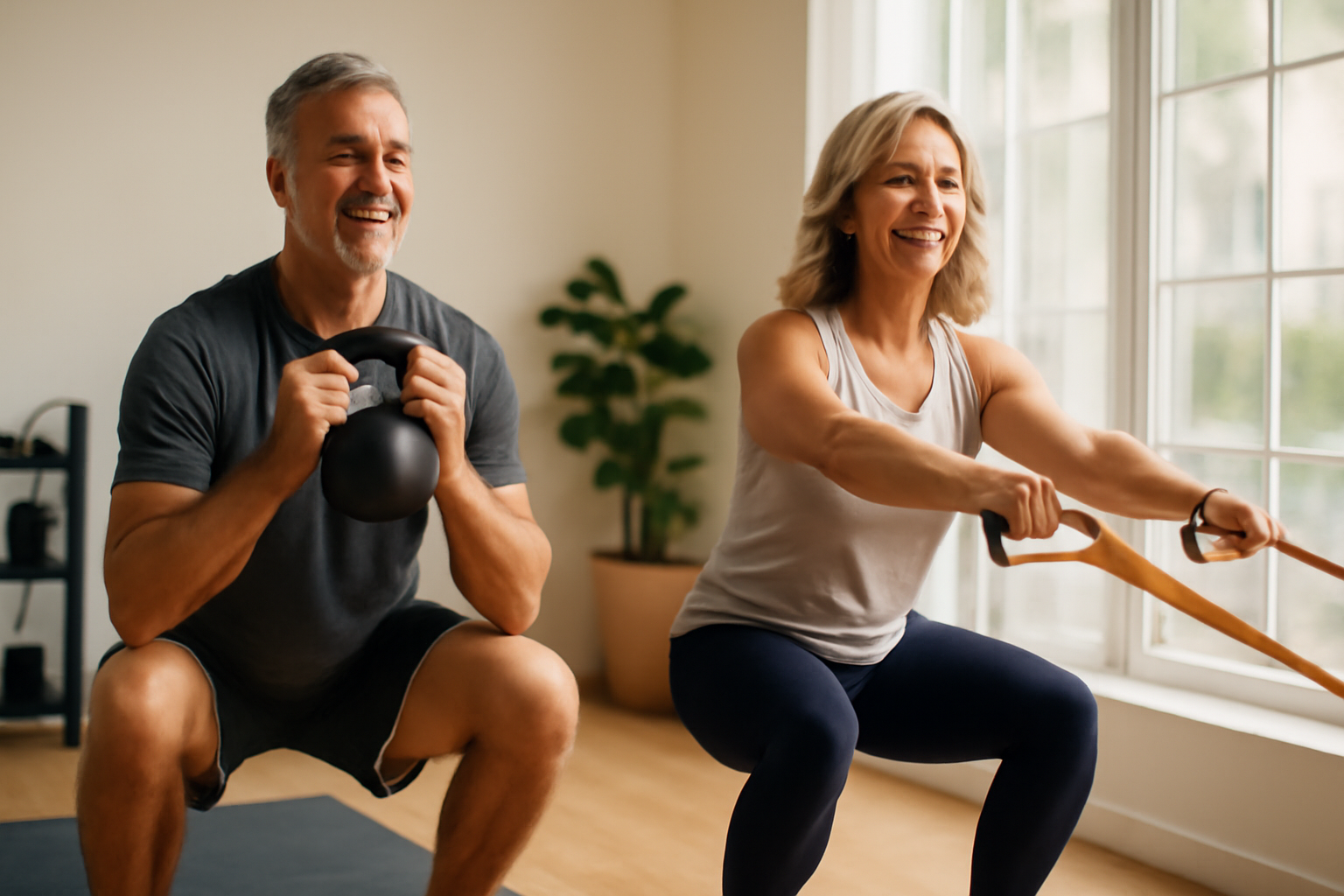
    1. Squat — sitting down and standing up, getting in and out of a car, picking something off a low shelf. Exercises: bodyweight squat, goblet squat, box squat.

    2. Hinge — bending at the hips to pick something up from the floor. This is the movement most people perform incorrectly, leading to back injury. Exercises: Romanian deadlift, kettlebell deadlift, hip hinge drill.

    3. Push — pushing a door open, rising from the floor, overhead reaches. Exercises: wall push-up, incline push-up, dumbbell press.

    4. Pull — opening heavy doors, pulling yourself up, carrying bags. Exercises: resistance band row, dumbbell row, assisted pull-up.

    5. Carry — transporting groceries, luggage, or any load while walking. Exercises: farmer’s carry, suitcase carry, waiter’s carry.

    6. Rotate and brace — turning to look behind you, twisting to reach, stabilizing your spine under load. Exercises: Pallof press, woodchop, dead bug.

    Research from Johns Hopkins Medicine emphasizes that training these patterns with light-to-moderate resistance, proper form, and progressive overload is more beneficial for adults over 40 than either high-intensity isolated exercises or no resistance training at all. This is not about becoming an athlete — it’s about becoming a capable, confident version of yourself.

    How to Build Your Functional Fitness Program

    Building an effective functional fitness routine after 40 doesn’t require a gym membership or expensive equipment. What it does require is consistency, smart progression, and attention to form.

    Frequency: The ACSM recommends that adults perform muscle-strengthening activities at least 2 days per week. For functional fitness specifically, 2 to 3 sessions per week allows adequate stimulus and recovery — especially important as recovery time increases with age. You can read more about why rest is a critical part of the equation in our guide to Recovery Days After 40: Why Rest Makes You Fitter.

    Session structure:

    • Warm-up (5-10 minutes): Dynamic mobility — leg swings, hip circles, thoracic rotations, arm circles. Avoid static stretching before training.
    • Main work (25-35 minutes): 3-4 exercises covering 2-3 movement patterns. Perform 2-3 sets of 8-12 reps each.
    • Cool-down (5-10 minutes): Gentle stretching and breathing. This is the time for static holds.

    Sample beginner session:

    • Goblet squat — 3 sets of 10 reps
    • Resistance band row — 3 sets of 12 reps
    • Hip hinge with dowel rod — 3 sets of 10 reps
    • Farmer’s carry — 3 lengths of 20 feet
    • Dead bug — 3 sets of 8 reps per side

    Progression: Research suggests adding difficulty every 2 to 4 weeks by increasing resistance, adding reps, reducing rest time, or introducing single-limb variations (such as a single-leg Romanian deadlift). This principle — called progressive overload — is what drives continued adaptation.

    If balance is a concern for you, pairing your functional training with dedicated balance work is highly recommended. Our guide to Balance Training After 40: Prevent Falls and Build Stability covers complementary drills that work well alongside functional fitness sessions.

    For those who prefer lower-impact options — particularly if you’re managing joint pain or are newer to exercise — many functional patterns can be modified significantly. See our Low-Impact Exercise After 40: The Complete Guide for exercise variations that reduce joint stress while preserving the functional benefit.

    Nutrition and Recovery: Supporting Your Functional Gains

    Exercise alone is only part of the equation. Clinical evidence consistently shows that nutritional support and adequate recovery are what allow the adaptations from training to actually take hold — especially after 40.

    Protein intake: The American College of Sports Medicine and the Academy of Nutrition and Dietetics jointly recommend that active adults over 40 aim for 1.2 to 1.6 grams of protein per kilogram of body weight daily to support muscle maintenance and repair. For a 160-pound adult, that’s roughly 87 to 116 grams per day. Distributing protein across meals — rather than concentrating it in one — appears to optimize muscle protein synthesis, according to NIH-reviewed research.

    Sleep: Growth hormone — which drives muscle repair and metabolic recovery — is primarily released during deep sleep. The CDC recommends that adults get 7 to 9 hours of sleep per night. Chronic sleep restriction below 6 hours has been associated with accelerated muscle loss and impaired physical performance in middle-aged adults.

    Hydration: Connective tissue, including tendons and cartilage, requires adequate hydration to function optimally. Dehydration as mild as 2 percent of body weight can impair strength output and increase injury risk, according to research reviewed by the Mayo Clinic.

    Anti-inflammatory eating: While no single food cures inflammation, diets rich in vegetables, fatty fish, nuts, and whole grains have been associated in multiple large cohort studies with reduced markers of systemic inflammation — which may support both joint health and muscle recovery in older adults.

    Living With Functional Fitness: Long-Term Strategies

    The most important thing about functional fitness is that it’s not a phase — it’s a lifelong practice. Here’s how to make it sustainable:

    Train for your life, not a program. Think about the physical demands of your daily routine and prioritize movements that directly address them. If your job involves sitting for hours, hip mobility and posterior chain strength should be central. If you’re a gardener, rotational strength and ground-to-stand work matter most.

    Track what matters. Instead of tracking only weight lifted, consider logging functional markers: how easily you can get up from the floor, your walking speed over a fixed distance, or your grip strength. These are clinically meaningful outcomes.

    Work with a qualified professional. A physical therapist or certified personal trainer with experience in older adult fitness can assess your movement patterns and identify compensations or weaknesses that generic programs miss. This is particularly valuable if you’re managing a chronic condition or recovering from injury.

    Embrace variety without losing the fundamentals. Yoga, tai chi, Pilates, and swimming all contain elements of functional fitness. Rotating formats can keep motivation high while reinforcing the core movement patterns that matter most. The core principle of functional movement can even be explored further through our guide to Mind-Body Exercise After 40: Yoga, Tai Chi and More.

    When to Call Your Doctor: Red Flags to Know

    Functional fitness is safe for the vast majority of adults over 40, but certain symptoms during or after exercise warrant prompt medical attention:

    Contact your doctor before starting if you have:

    • Uncontrolled high blood pressure or a recent cardiac event
    • Severe osteoporosis or a recent fracture
    • A recent surgery or joint replacement
    • Dizziness or unexplained chest discomfort at rest

    Seek emergency care immediately for:

    • Chest pain, pressure, or tightness during exercise
    • Sudden severe shortness of breath unrelated to exertion level
    • Severe dizziness, fainting, or loss of consciousness
    • Sudden sharp pain in a joint or muscle that doesn’t subside
    • One-sided weakness or facial drooping (potential stroke symptoms)

    Mention at your next appointment:

    • Persistent joint pain that worsens with activity
    • Unusual fatigue that doesn’t improve with rest
    • New or worsening balance problems
    • Any fall, even without injury

    The American Heart Association recommends that adults over 40 with no known conditions can generally begin moderate-intensity functional exercise without a prior medical evaluation — but those with existing chronic conditions should always check in with their healthcare provider first.

    Frequently Asked Questions

    Is functional fitness the same as physical therapy?
    Not exactly, though there is significant overlap. Physical therapy is a licensed medical intervention designed to treat injury or dysfunction under professional supervision. Functional fitness is a training philosophy that borrows many principles from physical therapy to build strength and movement quality in generally healthy individuals. Some people benefit from both.

    Can I do functional fitness if I have arthritis?
    Research suggests yes — in most cases. The Arthritis Foundation and the CDC both endorse low-to-moderate resistance training as beneficial for arthritis management, noting that it can reduce pain and improve joint function over time. The key is using appropriate loads, avoiding high-impact variations during flares, and working with a provider to identify safe modifications.

    How is functional fitness different from strength training?
    Strength training focuses on building muscular strength and hypertrophy (muscle size), often using isolation exercises. Functional fitness uses strength as a tool to improve movement quality and real-world performance. Many functional fitness exercises are strength exercises — but the goal and exercise selection differ. They work best together.

    How long before I notice results?
    This varies from person to person, but most people report feeling more capable in daily tasks within 4 to 6 weeks of consistent functional training. Objective improvements in balance, strength, and mobility are typically measurable within 8 to 12 weeks, according to NIH-reviewed studies on functional training in midlife adults.

    Do I need equipment for functional fitness?
    No. Many of the most effective functional exercises — bodyweight squats, hip hinges, push-ups, planks — require no equipment. Adding resistance bands, dumbbells, or a kettlebell can accelerate progress, but the movement patterns themselves can be trained at any fitness level with no gear at all.

    Conclusion

    Functional fitness is one of the most practical investments you can make in your long-term health after 40. It’s not about lifting the heaviest weights or training the hardest — it’s about moving well, moving safely, and staying capable for the life you want to live.

    The clinical evidence is clear: training the movement patterns your body actually uses every day reduces fall risk, supports muscle mass, improves balance, and enhances your quality of life in ways that isolated gym machines simply can’t replicate.

    Start where you are. Use the progressions that fit your current level. And remember that even modest, consistent functional training — two sessions per week over the long term — can make a profound difference in how you feel, move, and live as you age.

    Your body is built to move. Functional fitness is how you keep it that way.


    This article is for informational and educational purposes only. It does not constitute medical advice, diagnosis, or treatment. Always consult your physician or a qualified healthcare provider before making changes to your health routine or treatment plan.

    Medically reviewed by our editorial health team. Content follows evidence-based standards aligned with CDC and NIH guidelines.