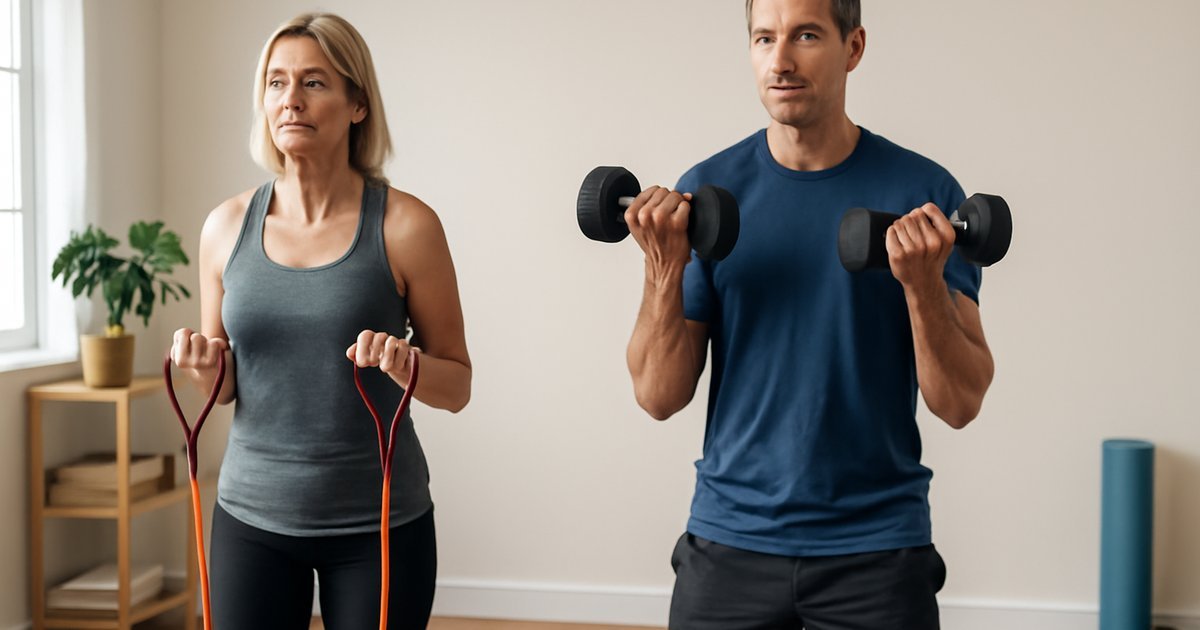
You don't need a gym membership or expensive equipment to get stronger, leaner, and healthier after 40 — you just need the right plan.
Why Working Out at Home Makes Sense After 40
Meet David, 52, a project manager from Ohio. After his gym closed during a particularly hectic work quarter, he started exercising in his living room with a pair of resistance bands and a yoga mat. Six months later, his blood pressure had dropped, he'd lost 18 pounds, and his back pain — a constant companion for nearly a decade — had significantly improved. He never went back to the gym.
David's story isn't unusual. According to the American College of Sports Medicine, home-based exercise programs show comparable long-term adherence rates to gym-based training — and for adults over 40, consistency is everything. Between family obligations, demanding careers, and the physical realities of an aging body, the friction of commuting to a gym can silently sabotage even the best intentions.
In this guide, you'll learn exactly how to design and follow a home gym workout plan tailored to adults in their 40s, 50s, 60s, and beyond — one that builds real strength, supports joint health, boosts cardiovascular fitness, and fits into a real life. No equipment? Minimal equipment? Both work. Let's get into it.
What Changes About Fitness After 40?
Understanding the biological changes that happen after 40 isn't about making excuses — it's about working smarter. After 40, several key physiological shifts affect how your body responds to exercise.
Sarcopenia — the gradual loss of muscle mass — begins as early as your 30s and accelerates after 40. According to the National Institute on Aging (NIH), adults can lose 3–8% of muscle mass per decade without intervention. This loss doesn't just affect how you look — it slows your metabolism, weakens your bones, and increases your risk of falls and injury.
Meanwhile, hormonal changes — declining estrogen in women and testosterone in men — affect fat distribution, recovery time, and energy levels. Joints may take longer to warm up, and inflammation tends to linger longer after intense sessions.
The good news? Research published in the Journal of Strength and Conditioning Research confirms that consistent resistance training can significantly slow — and even partially reverse — age-related muscle loss at any age. Your home gym is a powerful tool against the biological clock.
Benefits of Home Gym Workouts for Adults Over 40
Clinical evidence strongly supports exercise as one of the most powerful preventive health tools available to adults over 40. A home workout routine specifically offers:
- Convenience and consistency: No travel time, no waiting for equipment, no weather concerns. Research suggests that removing environmental barriers dramatically improves long-term exercise adherence.
- Joint-friendly options: You control the surface, the equipment, and the intensity — making it easier to modify exercises when joints are stiff or sore.
- Cardiovascular health: The American Heart Association recommends at least 150 minutes of moderate-intensity aerobic activity per week for adults — all of which can be achieved at home.
- Mental health benefits: Regular physical activity is clinically associated with reduced symptoms of anxiety and depression, improved sleep quality, and sharper cognitive function — all areas that become increasingly important after 40.
- Cost savings: A modest home setup costs a fraction of annual gym membership fees, with no long-term commitment.
If you're also managing your weight alongside fitness, our guide on Exercise for Weight Management After 40 offers complementary strategies that pair well with a home-based program.
Essential Equipment for a Home Gym After 40
You don't need a squat rack or treadmill to build an effective home gym. Here's what actually delivers results for adults over 40, organized by investment level:
Zero Equipment (Bodyweight Only)
Bodyweight training is highly effective and requires no financial investment. Exercises like squats, push-ups, lunges, planks, glute bridges, and modified burpees can provide a full-body workout that challenges every major muscle group.
Minimal Investment ($50–$150)
- Resistance bands (set of 3–5): Versatile, joint-friendly, and ideal for strength training, stretching, and rehabilitation exercises.
- A pair of adjustable dumbbells: One of the most efficient investments for home strength training. Clinical evidence indicates free weights activate stabilizer muscles more effectively than machines.
- Yoga mat: Essential for floor work, stretching, and balance exercises — reduces joint stress on hard surfaces.
- Foam roller: Myofascial release (self-massage) with a foam roller has been shown in studies to reduce post-exercise soreness and improve range of motion.
Moderate Investment ($200–$500)
- Kettlebell (15–35 lbs): Exceptional for compound movements that combine strength and cardio, such as swings and Turkish get-ups.
- Pull-up bar (doorframe mounted): Supports upper body and core training with minimal space.
- Stability ball: Adds instability to exercises, improving core engagement and balance — especially valuable for adults managing lower back issues.
Most adults over 40 will find the minimal investment tier more than sufficient for a comprehensive, medically sound workout program.
The Complete Home Gym Workout Plan for Adults Over 40
The following plan is structured around recommendations from the CDC and American College of Sports Medicine: at least 2 days of strength training and 150 minutes of moderate cardio per week. This is a sample starting point — individual variation always applies, and this varies from person to person based on fitness level, health history, and goals.
Always consult your physician before starting a new exercise program, especially if you have a chronic condition, cardiovascular disease, or recent injury.
Sample Weekly Schedule
- Monday: Strength Training — Upper Body (30–40 min)
- Tuesday: Low-Impact Cardio (30 min walking in place, cycling, or step-ups)
- Wednesday: Strength Training — Lower Body & Core (30–40 min)
- Thursday: Active Recovery — Stretching & Mobility (20–30 min)
- Friday: Full-Body Circuit Training (35–45 min)
- Saturday: Moderate Cardio or Outdoor Activity (30–45 min)
- Sunday: Complete Rest or Gentle Yoga
Upper Body Workout (Monday)
Perform 3 sets of 10–15 repetitions for each exercise. Rest 60–90 seconds between sets.
- Push-ups (modify on knees if needed)
- Dumbbell bent-over rows
- Resistance band shoulder press
- Dumbbell bicep curls
- Tricep dips (using a sturdy chair)
- Resistance band chest press
Lower Body & Core Workout (Wednesday)
- Bodyweight squats or goblet squats
- Reverse lunges (easier on knees than forward lunges)
- Glute bridges or single-leg glute bridges
- Resistance band side steps (hip abductor strengthening)
- Plank hold (30–60 seconds)
- Bird-dog (core stability)
- Dead bug (lower back protection)
Full-Body Circuit (Friday)
Perform each exercise for 40 seconds, rest 20 seconds, then move to the next. Complete 3 rounds.
- Squat to overhead press (dumbbell or band)
- Push-up with shoulder tap
- Dumbbell Romanian deadlift
- Resistance band pull-apart
- Step-back lunge with knee drive
- Mountain climbers (slow and controlled pace)
- Plank with alternating arm reach
For adults who find floor-based core work challenging due to back or hip discomfort, our Core Strength After 40 guide offers targeted modifications that protect the spine while still delivering meaningful results.
Warming Up and Cooling Down: Non-Negotiable After 40
After 40, skipping the warm-up is one of the most common — and costly — mistakes adults make. A proper warm-up increases blood flow to muscles and joints, raises core body temperature, and primes the nervous system. This reduces injury risk and improves performance.
Clinical evidence from Mayo Clinic confirms that a 5–10 minute warm-up meaningfully reduces soft tissue injury risk during exercise.
5-Minute Warm-Up Sequence
- Arm circles (forward and back) — 30 seconds
- Hip circles — 30 seconds
- Leg swings (front-to-back and side-to-side) — 30 seconds each leg
- March in place with high knees — 60 seconds
- Torso rotations — 30 seconds
- Bodyweight squats (slow) — 10 reps
Cool-Down and Mobility (5–10 Minutes)
- Standing quad stretch (hold 30 seconds each side)
- Seated hamstring stretch
- Child's pose
- Hip flexor lunge stretch
- Chest opener stretch
- Slow deep breathing (diaphragmatic breathing) for 2 minutes
Recovery is as important as the workout itself — especially after 40. Our dedicated guide on Walking for Fitness After 40 is also an excellent active recovery option between strength sessions, as brisk walking supports cardiovascular health without stressing the joints.
Common Mistakes to Avoid in Your Home Workout
Even well-intentioned fitness routines can go wrong. Here are the most clinically relevant mistakes adults over 40 make — and how to avoid them:
- Skipping rest days: Muscle repair happens during recovery, not during training. Overtraining increases injury risk and promotes chronic inflammation — a real concern after 40.
- Ignoring pain signals: Muscle fatigue is expected. Joint pain, sharp pain, or pain that persists after 48 hours is not normal — it signals the need for medical evaluation.
- Progressing too fast: Research suggests increasing volume or intensity by no more than 10% per week to minimize overuse injury risk.
- Neglecting protein intake: The American Dietetic Association recommends 1.2–1.6 grams of protein per kilogram of body weight for older adults engaged in resistance training to support muscle protein synthesis.
- Holding your breath during lifts: This can spike blood pressure dangerously. Exhale on the effort phase, inhale on the return.
- Using poor form to lift heavier: Form always takes priority over load. Poor form dramatically increases injury risk, particularly for the lower back and knees.
When to Call Your Doctor: Red Flags During Exercise
Exercise is safe for the vast majority of adults — but certain symptoms require immediate medical attention. Stop exercising and seek emergency care if you experience:
- Chest pain, pressure, tightness, or pain radiating to the arm, jaw, or back
- Sudden severe shortness of breath disproportionate to your effort level
- Dizziness, lightheadedness, or fainting
- Heart palpitations that feel rapid, irregular, or accompanied by other symptoms
- Sudden severe headache during exercise
- Numbness or weakness on one side of the body
Schedule a non-emergency appointment if you experience:
- Joint pain that persists longer than 48–72 hours after exercise
- Consistent muscle soreness that doesn't improve with rest
- Sudden changes in exercise tolerance or unusual fatigue
- Any new symptom that concerns you during or after workouts
Before starting any new home gym program, adults over 40 with hypertension, diabetes, heart disease, or osteoporosis should consult their physician for clearance and personalized modifications.
Frequently Asked Questions
How many days a week should I work out at home after 40?
Most clinical guidelines — including those from the CDC and American College of Sports Medicine — recommend at least 2 days of strength training and 150 minutes of moderate cardio per week for adults. For most people over 40, a 4–5 day schedule with built-in rest and recovery works well. Start with 3 days if you're returning from a period of inactivity.
Can I build real muscle with just bodyweight exercises at home?
Yes — research suggests that bodyweight exercises performed with proper progression (more reps, slower tempo, harder variations) can produce meaningful muscle hypertrophy (growth), especially for beginners and intermediate exercisers. Over time, adding resistance bands or light dumbbells accelerates results significantly.
Is it safe to do strength training at home without a trainer?
For most healthy adults, yes — provided you start conservatively, prioritize form over load, and listen to your body. However, adults with chronic conditions, recent surgeries, or significant pain should work with a certified personal trainer or physical therapist initially to establish safe movement patterns.
How long before I see results from a home workout program?
This varies from person to person. Most adults report improved energy, mood, and sleep within 2–4 weeks of consistent training. Visible changes in muscle tone and body composition typically emerge after 6–12 weeks of consistent effort combined with adequate nutrition. Strength gains often appear sooner, within 3–4 weeks, due to neuromuscular adaptations.
What's the most important exercise type for adults over 40?
If forced to choose one, most sports medicine physicians and exercise physiologists point to resistance training as the highest-priority exercise modality for adults over 40 — because of its direct impact on muscle mass, bone density, metabolic rate, and functional independence. Pair it with regular cardio for the most complete health benefit.
Conclusion: Your Home Gym Is Your Long-Term Health Investment
Building a sustainable home gym workout habit after 40 is one of the most powerful health decisions you can make. The science is clear: consistent strength training and cardiovascular exercise reduce your risk of heart disease, diabetes, cognitive decline, osteoporosis, and injury — while improving your quality of life every single day.
You don't need a perfect setup or unlimited time. You need a smart plan, realistic expectations, and the commitment to show up consistently. Start where you are, use what you have, and build from there.
As always, work with your primary care physician to ensure your program is safe and appropriate for your individual health profile. Your body at 50 or 60 is not the same as it was at 30 — and that's not a limitation. It's simply a reason to train with more intention.
Medical Disclaimer: This article is for informational and educational purposes only. It does not constitute medical advice, diagnosis, or treatment. Always consult your physician or a qualified healthcare provider before making changes to your health routine or treatment plan.
Medically reviewed by our editorial health team. Content follows evidence-based standards aligned with CDC and NIH guidelines.