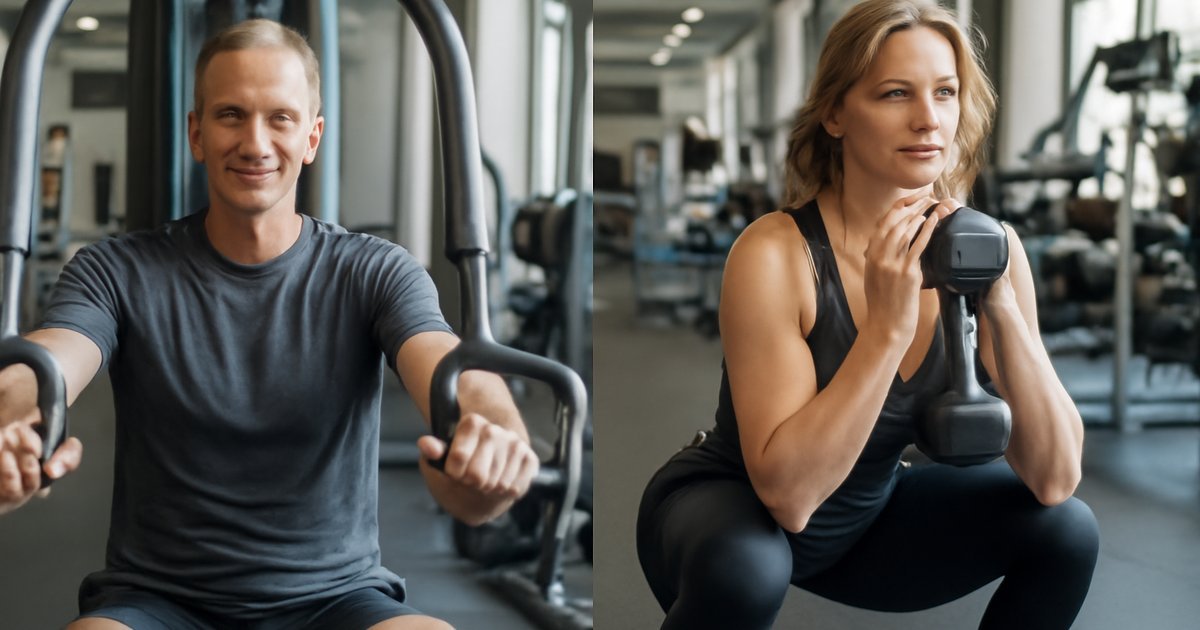
Your choice of equipment at the gym could be the difference between building lasting strength and spending time on the sideline with an injury.
Introduction
Robert, 54, had been lifting weights on and off since his twenties. When he rejoined his local gym after a five-year break, he stood in the middle of the weight room genuinely unsure where to start. The free weights felt familiar but risky. The cable machines looked safer but confusing. Sound familiar?
According to the CDC, less than 25% of American adults meet the recommended guidelines for both aerobic activity and muscle-strengthening exercise. For adults over 40, resistance training is not optional — it is one of the most powerful tools available for preserving lean muscle mass, protecting joints, managing weight, and reducing the risk of chronic disease.
But here is the question that stops a lot of people in their tracks: should you be using gym machines or free weights? Both have real benefits. Both carry some risks. And the best answer for you depends on your age, fitness level, goals, and any existing conditions you are managing.
In this guide, you will get a clear, evidence-based breakdown of gym machines versus free weights — what the research says, who benefits most from each, and how to build a smart approach that works for your body after 40.
Why Resistance Training Matters More After 40
Starting around age 30, most adults lose between 3% and 8% of their muscle mass per decade — a process called sarcopenia. After 60, that rate can accelerate. Research published in the Journal of the American Geriatrics Society found that adults who maintain muscle mass through resistance training have significantly lower rates of disability, falls, and metabolic disease compared to sedentary peers.
The good news: both gym machines and free weights can effectively combat sarcopenia when used consistently. The key is choosing the right tools for your specific situation.
Clinical evidence from the NIH suggests that resistance training at least two days per week reduces all-cause mortality risk by up to 23% in adults over 40. That is a compelling reason to get started — or get back on track.
Whether you use a leg press machine or a barbell squat matters far less than the fact that you are loading your muscles with progressive resistance over time. Still, the differences between machines and free weights are meaningful and worth understanding.
Gym Machines: What They Are and How They Work
Gym machines guide your body through a fixed range of motion using cables, pulleys, weight stacks, or pneumatic resistance. Common examples include the leg press, chest press machine, lat pulldown, seated row, and cable crossover.
The defining characteristic of machine-based training is that the movement pattern is controlled for you. The machine stabilizes the load, so your muscles can focus on producing force in a specific direction without requiring much balance or coordination.
According to data from the American College of Sports Medicine, machine-based training is often recommended as the starting point for beginners, older adults, and people returning from injury — precisely because the reduced stabilization demand makes it safer and easier to learn proper form.
Key advantages of gym machines for adults over 40:
- Lower injury risk for beginners and those with joint issues
- Easier to learn correct movement patterns
- Reduced need for a spotter when training alone
- Effective for isolating specific muscle groups during rehabilitation
- Adjustable weight in small increments, allowing gradual progression
- Useful for training to muscular failure more safely
Limitations to keep in mind:
- Fixed range of motion may not fit every body type
- Less activation of stabilizing muscles compared to free weights
- Generally less functional carryover to real-world movements
- Equipment availability varies by gym
Free Weights: What They Are and How They Work
Free weights include dumbbells, barbells, kettlebells, and any implement where the resistance moves freely in three-dimensional space. Unlike machines, free weights require your body to stabilize the load throughout the movement, engaging a broader network of muscles including the core and smaller supporting muscle groups.
A landmark study published in the Journal of Strength and Conditioning Research found that free weight exercises like the squat and deadlift produced significantly greater activation of trunk stabilizing muscles compared to machine equivalents — which has direct implications for functional strength, balance, and injury prevention over time.
Key advantages of free weights for adults over 40:
- Greater activation of stabilizer muscles, improving balance and coordination
- More functional — movements mimic real-life activities like lifting, carrying, and pushing
- Wider range of motion that can be adapted to individual anatomy
- Proven to build strength and muscle mass effectively at any age
- Versatile — one set of dumbbells can replace dozens of machines
Limitations to consider:
- Higher learning curve — proper form takes time and practice to master
- Greater injury risk if technique is poor or load is excessive
- Typically require more body awareness and coordination
- Some exercises benefit from a spotter for safety
If you are newer to free weights, starting with dumbbells rather than barbells is generally a smarter, safer approach. You can read more about how to get started in our guide to Bodyweight Training After 40, which provides a foundation before adding external loads.
What the Research Actually Says: Machines vs. Free Weights
The scientific literature on this topic has evolved considerably over the past decade. The short answer is that both modalities build muscle and strength effectively — but they do so through slightly different mechanisms and with different risk profiles.
A 2019 meta-analysis published in Sports Medicine reviewed 12 controlled studies comparing machine and free weight training outcomes. Researchers found no statistically significant difference in overall muscle hypertrophy (growth) between the two approaches when volume and intensity were matched. Both groups got stronger. Both groups gained lean mass.
However, free weight groups consistently showed greater improvements in dynamic balance and functional movement assessments. Machine groups showed slightly lower injury rates among beginners during the first eight to twelve weeks of training.
For adults over 40, this research suggests a practical conclusion: machines may be the smarter starting point, while free weights offer greater long-term functional benefits as your form and confidence improve.
Clinical evidence from the Mayo Clinic also supports the idea that combining both modalities — using machines for isolation work and free weights for compound movements — may produce superior outcomes compared to using either approach exclusively.
Joint Health and Injury Risk: A Critical Consideration After 40
By the time you reach your forties, fifties, or sixties, the conversation about joint health becomes central to every fitness decision. Osteoarthritis affects more than 32.5 million American adults, according to the CDC, and many people in the 40-to-70 age range are managing some degree of joint wear, stiffness, or pain.
This is where the choice between machines and free weights becomes genuinely nuanced.
Machines allow you to load muscles without requiring the joint to move through unpredictable planes of motion. For someone managing knee pain, a leg press machine may allow effective quadriceps training that a barbell squat cannot. For someone with shoulder impingement, a cable machine can replicate pressing patterns at angles that protect the rotator cuff.
On the other hand, free weights — when used with proper technique and appropriate load — can actually strengthen the tendons, ligaments, and stabilizing muscles that protect joints over time. Research published in Osteoarthritis and Cartilage found that progressive resistance training reduced joint pain and improved function in adults with knee osteoarthritis when performed under proper guidance.
The takeaway: if you are managing joint pain or recent injury, machines are often the safer starting point. As you build strength and stability, gradually incorporating free weight movements under the guidance of a physical therapist or certified personal trainer can pay long-term dividends.
For additional strategies on exercising safely with joint pain, see our in-depth guide on Foam Rolling After 40: Recovery, Mobility and Pain Relief.
Building Your Strategy: Who Should Use What
Rather than declaring one approach the winner, most exercise physiologists and sports medicine physicians recommend a personalized, progressive approach based on where you are starting from.
If you are new to resistance training or returning after a long break:
Start with machines for the first 6 to 12 weeks. Focus on learning controlled movement, building basic strength, and developing confidence. This phase reduces injury risk and prepares your muscles and connective tissue for more demanding work.
If you have an existing injury or chronic joint condition:
Work with your physician or a physical therapist to identify which machine exercises are appropriate. Avoid free weight movements that stress the affected joint until cleared to do so. This varies from person to person, so individualized guidance is essential.
If you have been training consistently for six months or more:
Integrate free weight compound movements such as goblet squats, Romanian deadlifts, dumbbell rows, and overhead presses. These movements build functional strength that translates directly to daily activities and long-term independence.
If you have a specific physique or performance goal:
Use a combination. Machines are excellent for targeted muscle isolation and training to failure safely. Free weights are superior for building raw strength and athletic carryover. A well-designed program uses both strategically.
Research from Johns Hopkins Medicine reinforces this blended approach, noting that functional training — combining stability work with loaded compound movement — produces the best outcomes for adults over 40 in terms of strength, body composition, and quality of life.
Practical Tips for Getting Started Safely
Regardless of which equipment you choose, how you train matters as much as what you train with. Here are evidence-based principles that apply to both machines and free weights for adults over 40:
- Prioritize form over load. Using too much weight with poor technique is the most common cause of resistance training injuries at any age. Start lighter than you think you need to.
- Progress gradually. The principle of progressive overload — gradually increasing resistance, reps, or volume over time — is what drives adaptation. Increase load by no more than 5-10% per week.
- Warm up thoroughly. Spend 5 to 10 minutes on light cardio and dynamic stretching before lifting. Cold muscles and connective tissue are more vulnerable to strain.
- Allow adequate recovery. Research suggests that adults over 40 may need 48 to 72 hours of recovery between sessions targeting the same muscle group. Two to three resistance training sessions per week is a well-supported starting point.
- Consider working with a professional. A certified personal trainer or exercise physiologist can assess your movement patterns and design a program that matches your health status and goals. Even two or three sessions can be enormously valuable.
- Listen to your body. Muscle soreness after training is normal. Sharp joint pain, swelling, or pain that persists more than 48 hours is a signal to back off and consult a healthcare provider.
You can also explore how to optimize your fuel for these sessions in our guide on Kettlebell Training After 40, which covers load management and progressive training principles in a practical format.
When to Call Your Doctor Before Starting
For most healthy adults, beginning a resistance training program at moderate intensity does not require physician clearance. However, there are important exceptions.
Consult your doctor before starting resistance training if you:
- Have been diagnosed with cardiovascular disease, heart failure, or have had a recent cardiac event
- Are managing uncontrolled hypertension (blood pressure consistently above 180/110 mmHg)
- Have had a recent surgery, fracture, or acute musculoskeletal injury
- Are experiencing unexplained shortness of breath, chest pain, or dizziness during physical activity
- Have been diagnosed with severe osteoporosis — specific loading guidelines apply
- Are managing a neurological condition that affects balance or coordination
Red flags that require immediate medical attention during or after training:
- Chest pain, pressure, or tightness
- Sudden shortness of breath disproportionate to effort
- Dizziness, lightheadedness, or near-fainting
- Sudden severe joint pain or a popping sensation followed by swelling
- Rapid or irregular heartbeat during moderate exercise
The American Heart Association recommends that adults with known cardiovascular risk factors discuss exercise intensity and type with their physician before significantly increasing activity levels.
Frequently Asked Questions
Are gym machines or free weights better for losing weight after 40?
Both can support weight management when combined with appropriate nutrition and cardiovascular activity. Research suggests that compound free weight movements may produce a slightly higher post-exercise metabolic response — meaning you burn more calories in the hours following training. However, the best approach is the one you will stick with consistently. This varies from person to person.
Can I build real muscle using only machines?
Yes. Multiple clinical studies confirm that machine-based training produces measurable muscle hypertrophy when progressive overload is applied consistently. Free weights may offer a slight edge for functional strength development, but machines are a legitimate and effective tool for building lean mass at any age.
Is it safe to lift heavy weights after 50?
Clinical evidence indicates that heavy resistance training — defined as loads requiring significant effort to complete 6-10 repetitions — is safe and beneficial for most healthy adults over 50. In fact, heavier loading with proper form may be more effective at preserving bone density and muscle mass than lighter, high-repetition work. Always work up to heavier loads gradually and consult your doctor if you have bone density concerns.
How many days per week should I do resistance training after 40?
Most physicians and exercise scientists recommend two to three sessions per week for adults over 40, allowing at least 48 hours of recovery between sessions that target the same muscle groups. The CDC’s physical activity guidelines recommend muscle-strengthening activity on two or more days per week as a minimum.
Do I need a personal trainer to use free weights safely?
You do not strictly need a trainer, but investing in a few sessions with a certified professional can dramatically reduce your injury risk and accelerate your progress. Even watching high-quality instructional content from credentialed sources and starting with light loads can be sufficient for many adults. If you have any health conditions or movement limitations, professional guidance is strongly recommended.
Conclusion
The debate between gym machines and free weights does not have a universal winner — and that is actually good news. It means you have flexible, effective options regardless of your fitness level, health history, or available equipment.
For most adults over 40, the smartest path combines the safety and accessibility of machine-based training with the functional, full-body demands of free weight movement. Start where you are, progress thoughtfully, and remember that consistency over months and years matters far more than any single equipment choice.
Resistance training is one of the most powerful investments you can make in your long-term health. Whatever gets you into the gym regularly — and keeps you there without injury — is the right answer for you. Talk to your doctor or a certified fitness professional to build a plan that fits your body and your goals.
Medical Disclaimer: This article is for informational and educational purposes only. It does not constitute medical advice, diagnosis, or treatment. Always consult your physician or a qualified healthcare provider before making changes to your health routine or treatment plan.
Medically reviewed by our editorial health team. Content follows evidence-based standards aligned with CDC and NIH guidelines.
Leave a Reply